Download our Sermons on Audio!
Listen to a recent sermon in the comfort and convenience of your own home!
View all >
| << | Jul 2008 | >> | ||||
| S | M | T | W | T | F | S |
| 1 | 2 | 3 | 4 | 5 | ||
| 6 | 7 | 8 | 9 | 10 | 11 | 12 |
| 13 | 14 | 15 | 16 | 17 | 18 | 19 |
| 20 | 21 | 22 | 23 | 24 | 25 | 26 |
| 27 | 28 | 29 | 30 | 31 | ||
Broadway Covenant Church is a vibrant fellowship, connected to the Evangelical Covenant Church but guided and governed by its own Rockford area membership and Broadway Covenant Church bylaws.
We keep our activities and organization vital through continual input from our members, participants and friends. Our worship services, church activities and organizational structure adapt to serve and fulfill our members and participants.
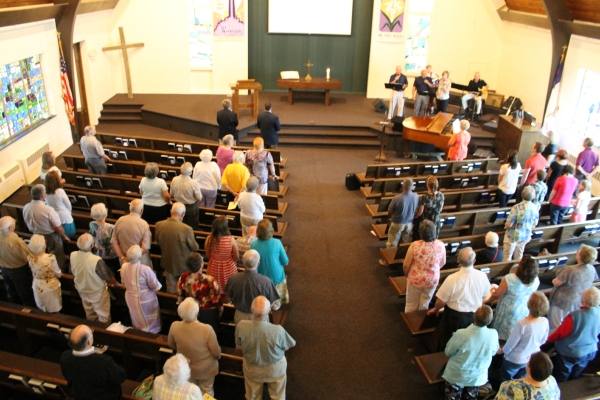
For instance, we changed our worship format this spring in response to member preferences. Our "new worship format" begins with "Energize," when recorded audio/visual in the sanctuary provides a time for worship preparation. Next, the Worship Band leads praise songs before we go into the teaching time and conclude with hymns.
To help you stay informed of such developments, this page provides several resources:
Concluding the Annual Meeting on May 21, 2008, we gathered around tables to discuss the new worship format. Each person was asked four questions. Their responses were written down and we are now in the process of summarizing and synthesizing the answers with other conversations about worship with those who were unable to participate in the Annual Meeting. As of press time, our leadership has not yet reviewed the responses. The questions were these:
1. What have you appreciated most about the new worship format?
2. What have you appreciated least about the new worship format?
3. Do you have any suggestions to improve the new format?
4. Which do you prefer - the old “blended” style or the new format?
To review, the purpose behind the new format was to provide people with the opportunity to experience the music they appreciate most (and avoid that which they don’t) while maintaining our unity. One overarching response has been that people are grateful and thankful that we are trying something to accommodate folks who may be dissatisfied with our current style of worship. Most people were against the new idea from beginning but saw its value in trying something new. However, there is also a sense that we are “giving in” to those who complain, because the vast, overwhelming majority of Broadway’s members and attenders appreciate our former worship style.
One demographic surprise from the survey and conversations has been the support for the new format from older folks in the church. The other overarching response from everyone from everyone regardless of age is that people may have a preference for a particular worship style, but no matter the style, they remain committed to Broadway. In other words, music style and worship organization is not the main thing for people about Broadway. To me, this is an incredibly refreshing and encouraging response. This means people are committed to Broadway’s vision and purpose and mission to reach people who are lost and lead them to become fully-devoted followers of Christ.
In terms of what people appreciate about the new format, responses include knowing what to expect, having the opportunity to choose a particular style, experiencing a variety of music, greater participation among age groups, the Energize section, and maintaining our unity by keeping one service.
Regarding what people appreciated least and suggestions for improvement, there were two main categories - practical and philosophical.
On the philosophical side, some don’t like being “boxed” into a schedule, giving in to negativity, “feeling judged” if leaving early, and some question whether we can achieve unity through division like this.
On the practical side, suggestions abound. Transitions could be smoother, the greeting times are awkward, and some feel we stand too much. Unfortunately, many suggestions conflict with each other. For example, some like hearing the readings during the worship band and the hymns sections; others suggest reading only once to avoid redundancy. Likewise, some really like the Energize - the videos, volume, selections, lighting, and the sense of excitement and anticipation. Others suggest turning the lights on, showing no videos, turning down the volume. Some like having instrumentation “underneath” readings and prayers; others don’t. However, I agree that the music underneath needs to be subtle and soft.
Clearly, there is no way to please everyone - not that anyone believed that was possible. Please remember a watchword for this experience - freedom. You are free to come early and leave early. Please feel free to stand or sit when we sing. You are free to come late and stay to the end. You are free to experience the music you appreciate without being looked down upon or judged.
As to the results of question 4’s expression of preference, a slight majority of those attending the Annual Meeting who stayed until the very end participating in the discussion “prefer” the new format over the blended style. I cannot say with any certainty whether the new format will remain. Our new Leadership Team needs to review and discuss the results of the survey. We probably need to inquire more deeply of others who weren’t in attendance at the Annual Meeting. We may need to creatively explore ways of managing the service regarding lights and volume and transitions.
For the sake of planning through the summer, we will probably keep the new format with the possibility of making changes in the fall. So to help in this process, please pray and continue to leave your (bad) attitude at the door. I look forward to the day when we can take all this energy focused on worship reflection and aim it toward our mission - reaching our friends and families and neighbors and neighborhoods with the gospel of Jesus Christ: the good news of God’s kingdom. Please join me in this mission.
Worshipfully,
Pastor Eric
Our new worship format, which segments our service into three parts - contemporary music followed by teaching followed by traditional music, brings good news and bad news. Surprisingly, both the good news and the bad news are the same: “Houston, we have a parking problem!” A parking problem is good news because it means our parking lot is full and more people are attending worship. But the parking problem is bad news because those who need the closest parking spaces arrive at or near the end of the contemporary music and have had to park down the street. Thus, during week two of the experiment, many of you saw the cones cordoning off four spaces and wondered, “What’s with the cones?" Or perhaps you arrived a little after 10:30 and found a couple sweet parking spots right in front and wondered, “Wow! How did I get so lucky? Now you know. But, if you are young and reasonably able bodied, or if you aren’t too young but are still quite able bodied, please try to avoid parking in the spaces closest to the building on the east side of the church.
I have been amazed at virtually everyone’s hopeful interest and desire to see what’s going to happen and what the new experience will be like. Curiosity has neither killed the cat nor ushered in the end of the world as we know it by tweaking our music orientation. One exciting aspect of this experience has been to see people change their perspectives. There were those who told me ahead of time that this idea was a bad one because they really liked our current worship and didn’t think the hue and cry about music was worth such drastic changes. However, many of those now say, “Hey, this really works. I can see the value in organizing the music in this way.” In addition, many who were not sure what to expect ahead of time have told me how much they appreciate the new format. On the other hand, some who went in with an open mind have told me they prefer it the old way. Others value the effort but aren’t yet convinced by the execution. Still others wish we would organize things a little differently. And last, a very small number was negative about our worship previously, and sadly, these attitudes are unchanged. In spite of that final category, I am most grateful for the conversations that now constructively discuss worship. People are talking about worship in positive, helpful, and thoughtful ways, which indicates to me that we are putting aside our overly-critical natures, and instead, we are focusing on worshipping God and bringing others to Christ. This is progress regardless of our worship format.
Our next step in worship happens at our Annual Meeting on May 21. Everyone is invited members and friends of Broadway. We will have conversations around our tables in Fellowship Hall for the purpose of gathering our collective reactions to this new worship format. While we won’t subject the way we organize worship to a vote, we will collect data to help inform us how best to design worship that makes sense based upon our particular context, history, and resources. If the overwhelming sense is, “Boy, that new worship format was sure a bad idea,” then we’ll probably go back to what we had been doing beforehand. Perhaps there will be sentiment to try the hymns first and follow the teaching with the band; therefore, during the summer, we may test drive another new idea. In other words, things may change yet again after the Annual Meeting. I know that change is difficult, but I am trying to be responsive to the needs of our people and our mission to proclaim the gospel of Jesus Christ to all people.
Seeking to lead Broadway to following Jesus,
Pastor Eric
You have heard the concept. You have left your bad attitudes at home. And now is the time, on April 13, to experience worship in a new way. Back in January after discussing worship with some very important people, Pastor Derek and I wrestled with how to plan worship in such a way to maintain our unity but to provide the opportunity for everyone to experience the music they appreciate most (and perhaps avoid that which they don't like). We settled on organizing worship in three parts. The first part is band-led contemporary music followed by our teaching time and then concluding with hymn-led traditional music. Everyone is free to come and go depending upon the music they desire to experience. Therefore, if you appreciate contemporary music, you are free to leave at the conclusion of the teaching time. If you appreciate traditional music, you are free to arrive at the beginning of the teaching time. Of course, everyone is free to attend the whole worship experience!
Here's what it will look like:
There is one "time certain" in this schedule – 10:45. This is the time that the worship band will conclude, and we will welcome one another including those who are just arriving. The other times are flexible. And along with the times, I hope we are all flexible and gracious. This idea may crash and burn, but if it does, may we crash and burn with grace and humility and love toward each other, You may not like the new schedule – that's okay – but I hope we can be gracious in our dislikes, right? Who knows, this may be the next great thing in worship. Most of the people I've talked to are not sure we need to make such drastic changes, but all have been supportive of trying something different.
From a practical standpoint, we need help in two important areas. First, we need ushers – men and women who are willing to commit to a schedule and assist in opening the sanctuary doors, taking the offering, and greeting those who are coming and saying goodbye to those who are leaving. Second, we need "lighting engineers" – a fancy title for men or women who can commit to a schedule to turn on and off our lights according to pre-arranged instructions.
We begin this experiment in worship on April 13 and continue until the Annual Meeting at which time we will gather and discuss in groups our experiences in worship over the previous several Sundays. Therefore, attendance each Sunday in worship and at the Annual Meeting is essential (when isn't it, though?) so that we can have a robust discussion of whether this schedule should continue.
In Hopeful Humility,
Pastor Eric
In 1985 when rock stars from around the world gathered to record "We Are the World," Quincy Jones, the song's producer, taped a hand-written sign above the door that said, "Check your egos at the door." The sign was a reminder to the rock stars, who are famous for their self-centered, self-indulgent natures, to remember the reason for their service: to provide hunger relief to the victims of the famine in Ethiopia.
I have found that attitudes impact actions. When I have a bad attitude, my behavior tends to be bad, too.
I learned this as a boy. Every few years, my family would travel to western Michigan for Thanksgiving with my mom's side of the family.
Western Michigan was home to the weird members of my mom's family. (Side note: Every family has a weird, freakish side. If you claim that your family lacks weirdoes, you might be the one.)
During the 3-hour drive, my mom, dad, brother and I would take turns lamenting the fact that we had to endure this drive AND spend time with the freaks. These lamentations would set the stage nicely for a terrible time to be had by all. (Another side note: I am overstating the experience and writing hyperbolically for dramatic effect.)
After enduring the experience and reliving it on the drive home, we would all agree that we were glad that we didn't have to do THAT for a few more years.
What I learned was that we set ourselves up for having a terrible time by having such bad attitudes to begin with. Our attitudes tend to be self-fulfilling prophecies: When we convince ourselves that we are going to experience something dreadful, chances are pretty good that we probably will.
In mid-April we will experience worship in new ways. Our services will be divided into three parts:
Some of us will come early for contemporary, band-led music and leave after the teaching time. Others of us will come late to experience the teaching and will stay for the traditional, hymn-led music.
Our attitudes will have a huge impact on the success of this worship experiment. If those who come early have judgmental, negative attitudes toward those who arrive a little later, then there is little likelihood that their worship experience will be positive. In fact, it is quite likely that their negative attitudes will filter into the teaching time, which is supposed to be a time to celebrate our unity together.
Likewise, if those who stay for the hymns have mean-spirited, judgmental attitudes toward those who leave early, then their worship experience will likely be negative, too. Everyone will then be ill-prepared to receive God's Word and worship Him.
So I invite you to "please leave your (bad) attitude at the door," once we start our worship experiment. In fact, please leave your (bad) attitude at the door each Sunday.
Come humbly to worship God, to seek Him and find Him, to be challenged and inspired, to receive encouragement and to bring joy to those around you.
Humbly hoping to worship Him in Spirit and in Truth,
Pastor Eric